


CONTACT US
MORE+
Jiangsu Guangyang Dynamic Environmental Equipment Co.,ltd
Tel:+0086-(0)510-87896688/87891880
Fax:+0086-(0)510-87896699
Address:Industry Area,East Town of GaoCheng,YiXing City,JiangSu Province,China
Post code:214214
E-mail:sh@gysh.com.cn
Website:www.gysh.com.cn


Anion and Cation Exchange
Anion and cation exchangers are exchangers filled with anion resin and cation resin respectively. Cation exchanger is used to remove positive charge ions (cations) and anion resins to remove negative charge ions (anions).
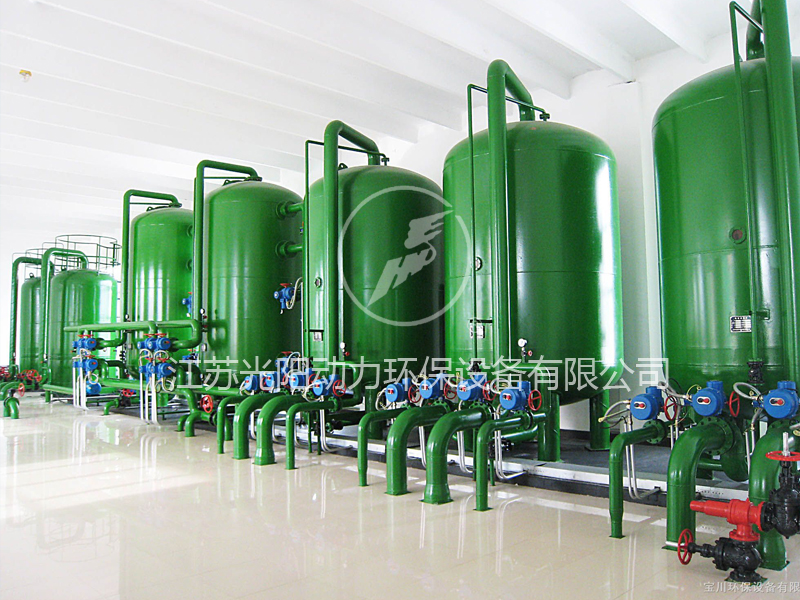
Ⅰ.Anion and Cation Exchange
Anion and cation exchangers are exchangers filled with anion resin and cation resin respectively. Cation exchanger is used to remove positive charge ions (cations) and anion resins to remove negative charge ions (anions).
Cation exchange resin replaces H+ ions with cations, such as calcium ions, magnesium ions and sodion ions; Anion exchange resin replaces OH- ions with anions, such as ammonia ions, sulfate ions and bicarbonate ions. The obtained H+ and OH- are synthesized into water, so as to remove ions in water.
Exchange capacity of the resin is also limited, and it must be regenerated after its exchange capacity exhausted. The exhausted state of its exchange capacity occurs when the adsorbed ions reach the balanced state. The regeneration of cation resin is treated with acid, it is usually regenerated with hydrochloric acid, that is, it is filled with H+ ions. The anion resin is usually regenerated with sodium hydroxide, that is, it is filled with OH+ ion. The regeneration can be carried out in the column by reproducible deionizing equipment and regeneration equipment as well as chemical agents.
Ⅱ. Regeneration Principle
The regeneration process of the ion exchanger adopts the countercurrent method without top pressure, which has the advantages of simple operation, external pipe system and no need to equip the equipment with top pressure. In the regeneration process, the diluted regenerating liquid flows backward from bottom to top to pass through the resin layers, and the resins in different layers will be regenerated from bottom to top. Firstly, in this way, the resin layers can be regenerated better, and the regenerating liquid can have a higher utilization rate. Secondly, it has the advantages of low wastewater discharge and low water consumption rate.
III. Technical Parameters
1.Inlet Water Turbidity: < 1- 2NTU
2. Outlet Water Quality:
Strong acid cation bed: sodium leakage is not greater than 100ug/l, and this value should be usually in 20-30ug/l
Strong alkali cation bed: SIO2 leakage is not greater than 100ug/l, and this value should be usually in 20-50ug/l. its outlet water conductivity is less than 2 us/cm
3. Operating Pressure: < 0.6MPa
4. Operating Temperature: 5- 50 °C
5. Operating Flow Velocity: 20-30m/h
6. Backwashing Intensity: cation resin is 10-15m/h, anion resin is 8-10m/h
7. Regeneration Flow Velocity: 5m/h
8. Concentration of Regenerating Liquid: 3-5%
Ⅳ.Structure
Shell of the Ion exchanger is usually made by rigid PVC, rigid PVC, composite FRP, plexiglass, plexiglass composite transparent FRP, steel lining glue, stainless steel lining glue and other materials. The inlet water device is equipped with the T-shaped wire winding type main branch pipe, the drainage device in the middle is also equipped with the T-shaped wire winding type main branch pipe, and the lower part is equipped with the structure of perforated plate + water cap collector.
There are all kinds of control valves and all kinds of instrument interfaces on the outside of the equipment, and it is convenient for the users to install the equipment on site and ensure the normal operation of the water station.
V. Main Applications
1. Production of pure water
2. Seawater desalination and brackish water desalination
3. Fluoride removal and wastewater treatment
4. Desalination of feed water for power equipment


 Copy product links
 Long by picture save/share
INQUIRY
enquiry form:
Inquiry Content:

You have no items to require

Add Successfully

Jiangsu Guangyang Dynamic Environmental Equipment Co.,ltd
Tel:+0086-(0)510-87896688/87891880
Fax:+0086-(0)510-87896699
Address:Industry Area,East Town of GaoCheng,YiXing City,JiangSu Province,China
Post code:214214
E-mail:sh@gysh.com.cn
Website:www.gysh.com.cn
Copying (C) 2018-2019 Jiangsu Guangyang Dynamic Environmental Equipment Co.,ltd All Rights Reserved.
暂无链接
